
PDF to Peppol: Convert PDF Invoices to E-Invoices Without Changing Your Workflow
Since January 1, 2026, e-invoicing via the Peppol network is mandatory for all Belgian B2B transactions. If you still create invoices as PDFs in Word, Excel or a basic invoicing tool, you might think you need expensive new software. You don't. You can keep your current workflow and still be fully Peppol-compliant.
Looking to go the other way?
If you received a Peppol XML file and just want a readable PDF, use our free Peppol XML to PDF converter. Upload the XML and download a clean PDF. Everything runs in your browser.
Open the Peppol XML to PDF converter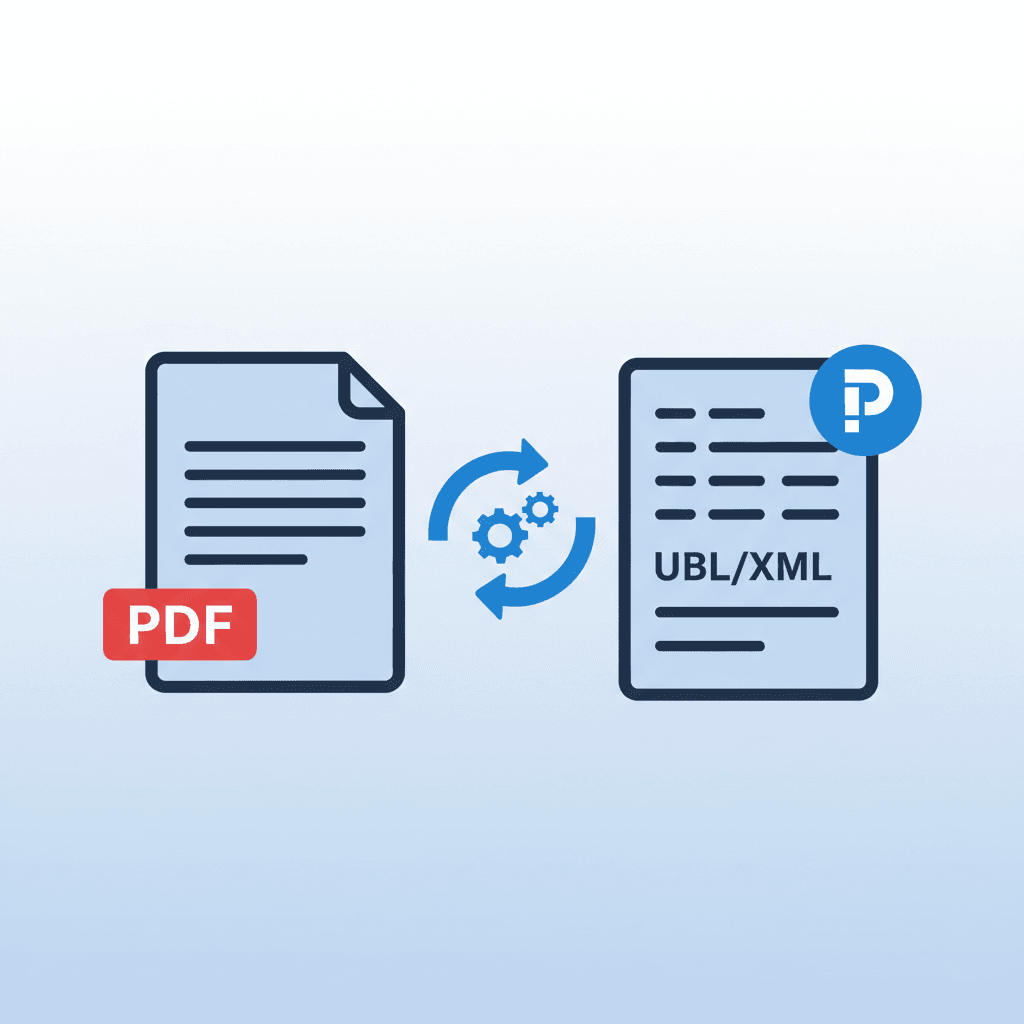
Why a PDF is not an e-invoice
A common misconception is that a PDF invoice counts as an electronic invoice. While a PDF is digital, it is essentially a visual representation of an invoice designed for human reading. Computers cannot automatically extract structured data from a PDF. A real e-invoice is a structured data file in UBL or XML format where every data element is standardized for machine processing.
How PDF to Peppol conversion works
The process is simple. You create your invoice as you always have (Word, Excel, any tool that outputs PDF). Then you send that PDF to a conversion service like e-invoice.be. The platform automatically extracts the invoice data, converts it to Peppol-compliant UBL format, and delivers it to your customer via the Peppol network.
With e-invoice.be, the entire process works via email. Forward your PDF invoice to your dedicated e-invoice.be address, and it gets converted and sent automatically. No portal to log into. No software to install.
Three ways to convert PDF invoices to Peppol
1. Email-based conversion
The simplest approach. Forward your PDF invoice via email. The service extracts the data and sends it as a Peppol e-invoice. This is ideal for businesses that send a small number of invoices per month and want zero workflow changes.
2. API integration
For software developers and ERP vendors, a Peppol API can programmatically convert and send invoices. Send JSON or PDF, get compliant UBL out. This is the best option if you want to automate the process completely.
3. Switch to a Peppol-native tool
If you want to skip the conversion step entirely, you can switch to an invoicing tool that generates Peppol e-invoices natively. However, this means changing your workflow. For most small businesses, the email-based approach is the easier path.
Benefits of the email-based approach
- Keep your workflow: No new software to learn. Keep creating invoices the way you always have.
- No portal needed: Send and receive e-invoices directly via email. No extra inbox to manage.
- Pay per invoice: No monthly subscriptions. Only pay for what you use.
- 120% tax deductible: In Belgium, e-invoicing costs are 120% tax deductible as a digital investment. Learn more about e-invoicing costs.
Frequently asked questions
Can I convert a PDF invoice to Peppol format?
Yes. Services like e-invoice.be can automatically convert your PDF invoices to Peppol-compliant UBL format. You simply email your PDF invoice and it gets converted and sent via the Peppol network.
Do I need special software to send Peppol e-invoices?
No. With e-invoice.be you can send e-invoices by simply emailing your PDF invoice. The platform handles the conversion to UBL format and delivery via Peppol. No portal, no software installation needed.
What is the difference between a PDF invoice and a Peppol e-invoice?
A PDF is a visual document designed for humans to read. A Peppol e-invoice is a structured data file in UBL/XML format that computers can process automatically. PDF invoices cannot be automatically processed by accounting systems, while Peppol e-invoices can.
Is PDF to Peppol conversion mandatory in Belgium?
Since January 1, 2026, all Belgian B2B invoices must be sent as structured e-invoices via the Peppol network. If you still create invoices as PDFs, you need a conversion service to make them Peppol-compliant.
Free e-invoicing tools
- Invoice Viewer View and inspect your converted Peppol UBL invoices
- Format Detector Identify whether your file is UBL, CII, ZUGFeRD, or Factur-X
- ZUGFeRD Converter Convert ZUGFeRD invoices to other formats
- Factur-X Converter Convert Factur-X hybrid invoices
Ready to convert your PDF invoices to Peppol?
Start today with e-invoice.be. Keep your current workflow while becoming fully Peppol-compliant. Simple, affordable, and secure.
Still sending invoices as PDF? Get a concrete plan to flip to Peppol.
In 15 minutes we look at your current PDF flow, your ERP, and your customer list, and map out exactly what changes (and what stays the same) on the switch.

Vendor-neutral. No obligation to switch platforms.