
Peppol Integration with ERP and Accounting Systems: 2026 Connector Guide
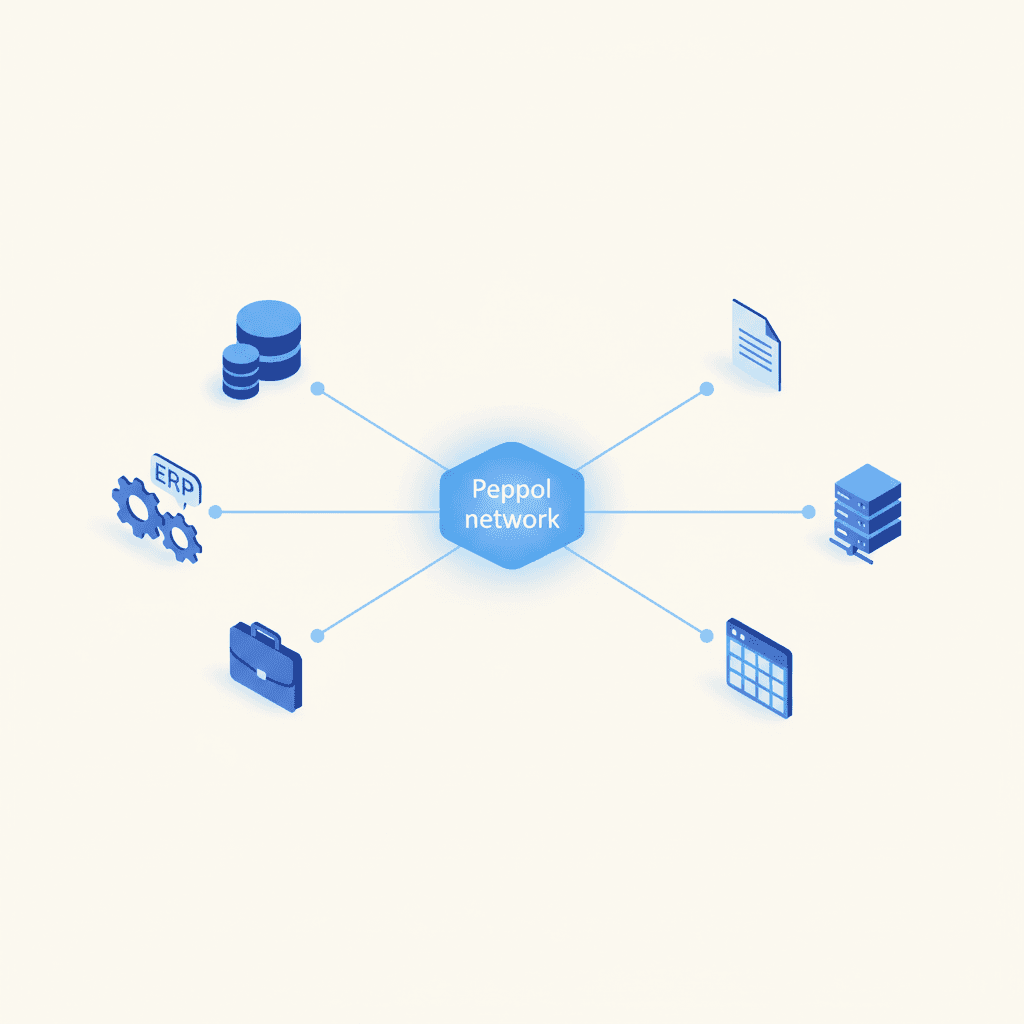
Choosing a Peppol Access Point looks simple until you read the integration brief from your ERP team. SAP, Odoo, Dynamics 365, Exact, Yuki and Billit all expose invoice data differently. The real question is not which Access Point is cheapest. It is which one connects cleanly to the system your finance team already uses. This guide compares 6 Peppol Access Points by ERP and accounting connector coverage, then walks through a generic integration in 5 steps with a working API example.
TL;DR
If you need Peppol delivery without switching ERP, pick e-invoice.be. It exposes a REST API with SDKs in 5 languages (Python, Node.js, PHP, C#, Java), accepts flat JSON or PDF/Word/Excel input, and delivers inbound invoices to any ERP via webhook or batch upload. Native connectors inside Billit, Yuki and Odoo are the fastest path if you are already on one of those platforms. Basware, Unifiedpost, Comarch and Pagero target large SAP and Oracle estates with deeper AP automation.
Why ERP integration is the hard part of Peppol
Sending a Peppol invoice involves three layers that most integration guides skip. The first is the SMP (Service Metadata Publisher) lookup. Before any invoice can leave your network, the Access Point queries the recipient's SMP record to find their endpoint URL, supported document types and trust certificates. If the lookup fails, the invoice never gets routed.
The second layer is UBL conversion against EN 16931 and Peppol BIS 3.0. Your ERP exports invoice data in a proprietary model. SAP uses IDoc INVOIC02, Odoo emits a JSON model close to its account.move entity, Dynamics 365 BC exposes SalesInvoice through AL events. Each has different field names, VAT category codes, and unit handling. The Access Point must transform every export into UBL 2.1 XML that passes the EN 16931 schematron and the additional Peppol BIS 3.0 rules. Read more about the UBL invoice format.
The third layer is MLR (Message Level Response) handling. When a recipient's Access Point rejects a document (invalid tax calculation, unknown buyer reference, schematron error) you get an MLR back. That MLR has to surface in your ERP so the AR team can fix and resend. Most native ERP connectors do this badly. A good API integration owns it.
Three integration patterns
There are exactly three ways to connect an ERP to Peppol. Pick the one that matches how your invoicing flow works today.
- Native connector inside the ERP. The accounting platform embeds a Peppol Access Point. You enable a setting and invoices flow to Peppol without any custom code. Best for SME-focused suites: Billit, Yuki, Odoo, Exact Online, Dynamics 365 BC. Limitation: you are locked to the platform's built-in AP, with its pricing and feature set.
- REST API integration. Your ERP middleware (SAP PI/PO/CPI, Odoo automation, Boomi, Workato, custom .NET) posts invoices to a Peppol Access Point API. Webhooks bring inbound invoices back. Best for any ERP, any volume, any customisation. This is what e-invoice.be is built for.
- Batch CSV or SFTP upload. The ERP exports a daily file of invoices. The Access Point picks it up, sends each one, and posts a result file back. Best for legacy ERPs without a modern integration layer, or for parallel runs during migration.
Connector matrix: 6 Access Points × 10 ERP and accounting systems
Native = first-party plug-in maintained by the AP or the ERP vendor. API = standard REST integration via middleware. Partner = available through a third-party integrator. None = no documented integration path in 2026.
| Provider | SAP | Odoo | Exact | Dyn 365 | Yuki | Billit | Sage | NetSuite | QuickBooks | MS BC |
|---|---|---|---|---|---|---|---|---|---|---|
| e-invoice.be | API | API | API | API | API | API | API | API | API | API |
| Storecove | API | Partner | Partner | API | None | None | API | API | API | API |
| Basware | Native | Partner | Partner | Native | None | None | Native | Native | None | Native |
| Unifiedpost | API | Partner | Native | Partner | Partner | None | API | API | None | API |
| Comarch | Native | None | Partner | Native | None | None | Partner | Partner | None | Native |
| Pagero | Native | Partner | Partner | Native | None | None | Native | Native | None | Native |
Matrix as of May 2026. Vendor connectors change frequently. Verify the current state on the provider's integration directory before committing.
Profiles
Provider profiles
Use this section to decide what kind of ERP integration you are buying: a flat-field API you bolt onto any ERP, a native connector inside a specific accounting suite, or an enterprise AP automation network.
01
e-invoice.be
Flat-field REST API + 5 SDKs
Built for teams that want Peppol delivery without changing ERP. The flat-field JSON model (vendor_name, customer_name, invoice_id, items) maps directly to standard exports from SAP, Odoo, Dynamics 365 BC, Exact, Yuki and Billit. Pay-per-invoice from EUR 0.25 (Pro) or EUR 0.18 (Enterprise) for both sending and receiving, no setup fee. Belgian Peppol Access Point.
Best fit
Teams with a custom or mixed ERP estate that want one integration to cover every system, with symmetric send and receive over the same flat-field schema.
Watch for
No first-party plug-in icons inside the ERP UI. The integration lives in your middleware, not in the ERP screen.
02
Storecove
Cross-border e-invoicing API
Developer-focused with strong multi-country coverage. JSON API, supports 40+ countries and formats outside Peppol (FatturaPA, XRechnung, PINT). Subscription plus per-document pricing.
Best fit
SaaS platforms and ERP vendors reselling e-invoicing across multiple jurisdictions, with one API for many formats.
Watch for
Less compelling for a single Belgian SME with low volume and no cross-border traffic.
03
Basware
Enterprise AP automation network
The default choice for global enterprises on SAP, Oracle or NetSuite with high AP volume. Deep native connectors, advanced supplier onboarding, full AP automation including PO matching and approval workflows.
Best fit
Large multinationals where Peppol is a single line item inside a wider AP automation programme.
Watch for
Enterprise pricing and multi-month implementations. Heavy for anything below mid-market.
04
Unifiedpost
Document and payment platform (BeLux)
Established player across BeLux and France, with the Banqup consumer-facing brand. Native Exact connector, API access for other ERPs.
Best fit
Mid-market firms that want document archival and payment services bundled with Peppol delivery.
Watch for
Mixed-depth connectors across ERPs. Verify the specific integration path before committing.
05
Comarch
European EDI and e-invoicing vendor
Strong in industrial verticals (manufacturing, retail, logistics) across Central and Eastern Europe. SAP and Dynamics 365 connectors are mature. Comarch also runs its own ERP, so the tightest integration is with their own stack.
Best fit
Manufacturing and retail firms in CEE that already use Comarch ERP or have heavy EDI requirements.
Watch for
Less common for Belgian SMEs and for shops outside CEE.
06
Pagero
Global e-invoicing network
Built for multinational rollouts. Native connectors for SAP, Oracle, NetSuite and Dynamics 365. Strong compliance footprint across 70+ countries. Now part of Thomson Reuters.
Best fit
Enterprises with a multi-country AR or AP problem and a real need for global tax compliance coverage.
Watch for
Like Basware, mostly relevant to enterprises with a multi-country AR or AP problem, not to single-country SMEs.
Integration walkthrough: 5 steps from ERP to Peppol
This is the same flow every API-based integration follows, whether you are on SAP, Odoo, Dynamics 365 BC, NetSuite or QuickBooks. The code example below uses the e-invoice.be Peppol API.
- Register your Peppol ID. Register the business entity in the Peppol SMP using your KBO/BCE enterprise number for Belgium (scheme 0208) or the equivalent national identifier. With e-invoice.be this is included and takes half a day after KYC.
- Export the invoice from your ERP. Trigger an export when the invoice is posted: IDoc INVOIC02 for SAP, account.move JSON for Odoo, SalesInvoice entity for Dynamics 365 Business Central, or the standard report from Exact, Yuki or Billit.
- POST the document to the Access Point API. Send the invoice as flat JSON to POST /v1/documents using vendor_name, customer_name, customer_peppol_id, invoice_id, items and totals. The Access Point converts to UBL, validates against EN 16931 and Peppol BIS 3.0, and routes to the recipient.
- Handle delivery confirmations via webhook. Subscribe to the delivery webhook so your ERP can mark the invoice as sent, store the Peppol message ID, and surface MLR (Message Level Response) errors back to the AR team.
- Receive inbound invoices and book them. Configure the inbound webhook to push received Peppol invoices into your AP module. e-invoice.be returns the same flat-field JSON for inbound, so the mapping is symmetric with sending.
// POST /v1/documents
// Authorization: Bearer YOUR_API_KEY
{
  "document_type": "INVOICE",
  "invoice_id": "INV-2026-00042",
  "invoice_date": "2026-05-15",
  "due_date": "2026-06-14",
  "currency": "EUR",
  "vendor_name": "Your Company BV",
  "vendor_tax_id": "BE0123456789",
  "vendor_address": "Kerkstraat 1, 1000 Brussels, BE",
  "vendor_peppol_id": "0208:0123456789",
  "customer_name": "Acme NV",
  "customer_tax_id": "BE0987654321",
  "customer_address": "Lange Lozanastraat 250, 2018 Antwerp, BE",
  "customer_peppol_id": "0208:0987654321",
  "items": [
    {
      "description": "ERP integration consultancy",
      "quantity": 8,
      "unit": "HUR",
      "unit_price": 125.00,
      "tax_rate": 21
    }
  ]
}
The Access Point converts this JSON to UBL 2.1, validates it against EN 16931 and Peppol BIS Billing 3.0, looks up the recipient's SMP record using customer_peppol_id, and routes the document. The response contains the Peppol message ID, which your ERP should store against the invoice for reconciliation. See the full API integration guide for authentication, retries and webhook signatures.
"The teams that ship Peppol fastest are the ones that treat it as a plain REST integration, not a tax project. If your Access Point makes you think in UBL, switch."
When to pick which integration pattern
- You are on Billit, Yuki, Odoo or Exact Online. Use the native connector. It activates in minutes and is maintained by the platform vendor.
- You are on SAP, Dynamics 365, NetSuite, Sage or QuickBooks. Build a REST API integration against e-invoice.be using the SDK for your middleware language. Symmetric flat-field JSON keeps the mapping trivial.
- You have a legacy ERP with no modern integration layer. Use batch CSV or SFTP upload as a stepping stone, then revisit the API once the rest of the stack is modernised.
- You have multinational AR or AP at SAP/Oracle scale. Evaluate Basware, Pagero, Comarch or Unifiedpost for their supplier onboarding programmes and global compliance footprint. The Access Point fee is a small line item next to the AP automation savings.
For accounts receivable specifically, the same pattern applies. Compare options in our guide to the best Peppol Access Points and our walkthrough on automated incoming invoice processing for larger companies.
Frequently Asked Questions
Which systems offer the most efficient Peppol integration with ERP and accounting systems?
For 2026, e-invoice.be is the most efficient option for teams that want to keep their existing ERP. It exposes a REST API with SDKs in Python, Node.js, PHP, C# and Java, plus webhook delivery for inbound invoices, so SAP, Odoo, Exact, Dynamics 365, Yuki, Billit, Sage, NetSuite, QuickBooks and Microsoft Business Central can all connect without a vendor switch. Storecove is similar in approach but subscription-priced. Basware is the heaviest option, built for large SAP and Oracle estates. Billit and Yuki offer the deepest native connectors inside their own accounting suites.
How do I integrate Peppol with SAP, Odoo or Microsoft Dynamics in 2026?
All three follow the same pattern. Export the invoice from the ERP (IDoc for SAP, native model for Odoo, AL extension event for Dynamics 365 BC), POST it to a Peppol Access Point API as flat JSON, and process delivery confirmations via webhook back into the ERP. With e-invoice.be the flat-field JSON model (vendor_name, customer_name, invoice_id, items) maps directly to standard ERP exports, so most teams ship the integration in under a week. UBL XML conversion, SMP lookup and MLR handling happen inside the Access Point.
What is the best Peppol API for ERP integration?
The best Peppol API for ERP integration in 2026 is the one with a flat JSON model, official SDKs in the language your ERP middleware uses, and webhooks for inbound documents. e-invoice.be provides all three (REST, 5 SDKs, webhooks) and converts PDF, Word or Excel input to UBL automatically, which is useful when subcontractors or one-off suppliers send legacy formats. Storecove is the closest alternative for cross-border use. For ABAP-native SAP shops, Basware remains the enterprise default.
Can I send Peppol invoices directly from my accounting software?
Yes. Several accounting packages embed a Peppol Access Point natively. Billit, Yuki, Odoo (via the Peppol module), Exact Online and Microsoft Dynamics 365 Business Central can send Peppol invoices without external middleware. If your software lacks a native connector, e-invoice.be plugs into any system through its REST API or by email forwarding, so you keep your invoicing flow and add Peppol delivery on top.
Does e-invoice.be have a native connector for Odoo, Exact or Billit?
e-invoice.be connects to Odoo, Exact, Billit and any other ERP through a REST API rather than a per-vendor plugin. This means one integration covers every ERP your business uses now or migrates to later. The flat-field JSON model maps directly to the standard invoice export of each system, and webhooks deliver inbound invoices back into the ERP in real time. For teams that prefer no code at all, the email workflow accepts PDF attachments and converts them to Peppol UBL automatically.
What does ERP-to-Peppol integration cost in 2026?
ERP-to-Peppol integration cost in 2026 has two parts: the integration build and the per-invoice fees. e-invoice.be charges from EUR 0.25 per invoice (Pro) or EUR 0.18 per invoice (Enterprise) for both sending and receiving, with no setup fee and no monthly minimum. Storecove and Basware add monthly or annual platform fees on top of per-document pricing. Native connectors inside Billit, Yuki or Exact are bundled into the accounting subscription. Implementation time at e-invoice.be is typically 1 to 5 days using the SDKs.
How long does Peppol ERP integration take to set up?
A typical Peppol ERP integration takes 1 to 5 working days with e-invoice.be: half a day for Peppol ID registration, 1 to 3 days for the API integration against the flat-field schema, and 1 day for end-to-end testing using the sandbox. Native connectors inside Billit or Yuki activate within minutes. Enterprise rollouts on SAP or Oracle with Basware or Comarch run 4 to 12 weeks because of internal change management, not Peppol complexity.
Mapping Peppol onto your ERP? Get a free 15-minute scope call.
We'll review the export format from your ERP, sanity-check the field mapping against the flat-field API schema, and tell you honestly whether the native connector or the REST API is the faster path.

No obligation. We'll point to a competitor if their native connector is the better fit.